Table of Contents
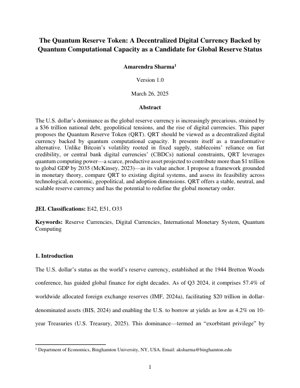
$36.2 Trillion
U.S. National Debt (123% of GDP)
57.4%
Dollar's Share of Global FX Reserves (Q3 2024)
>$1 Trillion
Projected Quantum Computing GDP Impact by 2035
1. Introduction
The U.S. dollar's eight-decade reign as the global reserve currency, established at Bretton Woods in 1944, is under unprecedented strain. A $36.2 trillion national debt, geopolitical fragmentation, and the rise of digital alternatives are eroding its foundations. While contenders like the Euro and Yuan face structural limitations, and cryptocurrencies like Bitcoin suffer from extreme volatility, a new paradigm is needed. This paper introduces the Quantum Reserve Token (QRT), a decentralized digital currency proposing to anchor its value not to a nation's promise or a finite digital commodity, but to the productive, scarce, and globally relevant asset of quantum computational capacity.
2. Literature Review
2.1 Reserve Currencies and Monetary Theory
Historical analysis by Kindleberger (1986) and Eichengreen (2019) demonstrates that reserve currency status is a function of economic hegemony, deep financial markets, and institutional trust. The Triffin Dilemma (Triffin, 1960) highlights the inherent conflict where the issuing country must run trade deficits to supply global liquidity, ultimately undermining confidence in its currency—a predicament evident in current U.S. fiscal policy. Prasad & Ye (2013) and Farhi & Maggiori (2018) explicitly link soaring debt-to-GDP ratios to reserve currency vulnerability, providing a theoretical basis for seeking an alternative not tied to any single nation's fiscal discipline.
3. The Quantum Reserve Token (QRT) Design
QRT is conceived as a decentralized digital currency whose value is algorithmically pegged to a global benchmark of usable quantum computational power. The core mechanism involves:
- Value Anchor: A basket of verifiable quantum computing resources (e.g., qubit count, quantum volume, algorithm-specific performance) from a decentralized network of providers.
- Issuance Mechanism: New QRT is minted and distributed in correlation with proven increases in the network's aggregate quantum capacity, linking money supply growth to productive asset growth.
- Governance: A decentralized autonomous organization (DAO) oversees protocol updates, validates capacity proofs, and manages the reserve composition.
- Stability Mechanism: Algorithmic stabilization protocols (akin to those in advanced algorithmic stablecoins) adjust supply in response to demand fluctuations, using the quantum capacity reserve as the ultimate backing.
4. Comparative Analysis
QRT is positioned as a third-way solution distinct from existing digital currency models:
- vs. Bitcoin (Store of Value): Replaces energy-intensive, fixed-supply scarcity with productive, growth-oriented scarcity from quantum computing.
- vs. Stablecoins (Medium of Exchange): Replaces reliance on fiat currency reserves (and their associated sovereign risk) with a technologically neutral, productive asset.
- vs. CBDCs (Unit of Account): Offers global neutrality and decentralization, avoiding the surveillance and control risks inherent in state-issued digital currencies.
5. Feasibility Assessment
The proposal's viability hinges on four pillars:
- Technological: Requires robust, standardized methods for measuring and verifying quantum computational output across heterogeneous hardware—a significant challenge given the nascent state of quantum utility.
- Economic: Depends on quantum computing achieving its projected >$1 trillion economic impact, creating genuine demand for the underlying asset.
- Geopolitical: Offers a neutral alternative attractive to nations seeking de-dollarization, but may face resistance from established powers.
- Adoption: Requires building trust in a completely novel monetary paradigm, likely starting with niche use cases in tech and finance.
6. Conclusion
The Quantum Reserve Token presents a radical and intellectually compelling vision for the future of money. It attempts to solve the Triffin Dilemma by anchoring value to a globally relevant, productive technological frontier rather than sovereign debt. While its practical implementation faces monumental technological and coordination hurdles, it successfully frames the search for a post-dollar reserve currency not as a choice between existing flawed options, but as an opportunity to architect a new system aligned with the next era of human technological progress.
7. Original Analysis & Expert Commentary
8. Technical Framework & Mathematical Model
The proposed valuation and issuance model can be abstracted as follows:
1. Quantum Capacity Index (QCI): A standardized measure of the network's productive power.
$QCI_t = \sum_{i=1}^{n} (w_i \cdot V_i(t) \cdot F_i(t) \cdot A_i(t))$
Where for each provider i at time t:
- $V_i(t)$ is the Quantum Volume (a holistic performance metric).
- $F_i(t)$ is the qubit fidelity/error rate.
- $A_i(t)$ is the algorithmic availability/throughput.
- $w_i$ is a governance-assigned weight based on reliability and decentralization.
2. QRT Supply Algorithm:
The total supply $S_t$ adjusts based on changes in the QCI and market demand (price deviation from peg $P_{target}$).
$\Delta S_t = \alpha \cdot (\frac{QCI_t - QCI_{t-1}}{QCI_{t-1}}) \cdot S_{t-1} - \beta \cdot (P_t - P_{target}) \cdot S_{t-1}$
The first term ($\alpha$) links supply growth to capacity growth. The second term ($\beta$) is a proportional feedback controller for price stability, similar to the PID controllers explored in algorithmic stablecoin design (e.g., Ampleforth's rebase mechanism).
3. Reserve Proof: Each QRT in circulation is backed by a verifiable claim on a tiny fraction of the global QCI, proven via cryptographic commitments (e.g., zk-SNARKs) from the quantum providers to the blockchain.
9. Analysis Framework: A Use Case Scenario
Scenario: A multinational pharmaceutical company needs to optimize a complex drug discovery simulation, a problem intractable for classical computers but suitable for quantum annealing.
Traditional Model: The company would contract directly with a quantum cloud provider (e.g., IBM, Google) using USD or EUR, facing high costs, vendor lock-in, and currency exchange risk.
QRT-Enabled Model:
- The company purchases QRT on an open market.
- It submits its computational job to the decentralized QRT network, paying a fee in QRT.
- The network's smart contract automatically auctions the job to the most efficient quantum provider(s) based on real-time QCI metrics.
- The provider executes the job, submits a proof of work, and is paid in QRT.
- The company receives the results.
Value Creation: The QRT used in this transaction is not just a payment token; it is inherently valuable because it represents a direct claim on the productive asset being consumed. This creates a closed-loop economy where the currency's utility and value are reinforced by its use in accessing the underlying resource, a powerful network effect absent in pure payment tokens.
10. Future Applications & Development Roadmap
The evolution of a concept like QRT would likely follow a phased, hybrid approach:
- Phase 1 (2025-2030): Proof-of-Concept & Standardization.
- Development of a robust, cross-platform QCI standard by a consortium (e.g., IEEE P7130).
- Launch of a "Quantum-Backed Stablecoin" pilot: A centralized entity (e.g., a tech fund) holds quantum computing equity and issues a tokenized IOU, building initial trust.
- Research into verifiable quantum computing proofs (zk-QC).
- Phase 2 (2030-2035): Hybrid Decentralized Network.
- Formation of a decentralized quantum compute marketplace (like Akash Network for cloud compute, but for quantum).
- The marketplace's native token begins to function as a proto-QRT, used for payments and governance.
- Initial algorithmic stabilization mechanisms are tested.
- Phase 3 (2035+): Full QRT Implementation & Reserve Aspiration.
- Maturation of quantum utility across finance, logistics, and materials science creates massive, inelastic demand for quantum compute.
- The marketplace token, now fully stabilized and backed by a vast, decentralized network, begins to be held as a reserve asset by corporations and eventually sovereign wealth funds seeking a neutral, productive store of value.
- Integration with DeFi and traditional finance for liquidity and lending markets denominated in QRT.
The ultimate application is a global financial system where capital allocation is seamlessly integrated with access to advanced computational resources, dramatically accelerating scientific and technological progress.
11. References
- Arute, F., et al. (2019). "Quantum supremacy using a programmable superconducting processor." Nature, 574(7779), 505–510.
- Bank for International Settlements (BIS). (2020). "Central bank digital currencies: foundational principles and core features." BIS Report.
- Buterin, V., et al. (2014). "Ethereum: A Next-Generation Smart Contract and Decentralized Application Platform." Ethereum Whitepaper.
- Eichengreen, B. (2011). Exorbitant Privilege: The Rise and Fall of the Dollar and the Future of the International Monetary System. Oxford University Press.
- Farhi, E., & Maggiori, M. (2018). "A Model of the International Monetary System." The Quarterly Journal of Economics, 133(1), 295–355.
- International Monetary Fund (IMF). (2024a). "Currency Composition of Official Foreign Exchange Reserves (COFER)."
- McKinsey & Company. (2023). "Quantum computing: An emerging ecosystem and industry use cases."
- Nakamoto, S. (2008). "Bitcoin: A Peer-to-Peer Electronic Cash System." Bitcoin Whitepaper.
- Prasad, E. S., & Ye, L. (2013). "The Renminbi's Role in the Global Monetary System." Brookings Institution Report.
- Triffin, R. (1960). Gold and the Dollar Crisis: The Future of Convertibility. Yale University Press.
- U.S. Treasury Department. (2025). "The Debt to the Penny." (Data extrapolated for illustrative purposes).
Core Insight:
Sharma isn't just proposing a new coin; he's attempting a philosophical reset of money itself. The core insight is that in a digital age, the "backing" of a currency need not be gold or government promise, but can be access to a critical, scarce, and exponentially growing form of productive capital—in this case, quantum supremacy. This moves the value proposition from trust in institutions to trust in technological progress and decentralized verification, a paradigm shift as significant as the move from commodity to fiat money.
Logical Flow:
The argument is structurally sound: (1) Establish the dollar's fragility, (2) Dismiss current alternatives as inadequate, (3) Identify quantum computing as a unique, high-value, neutral asset class, (4) Propose a tokenized bridge between this asset and global liquidity. The logic echoes the foundational work on "real backing" in monetary economics, but applies it to a 21st-century asset. However, it glosses over the transition period: how does one bootstrap a $1 trillion+ reserve currency from a nascent technology? The chicken-and-egg problem of liquidity is severe.
Strengths & Flaws:
Strengths: The proposal is visionary and addresses the root cause of current monetary instability—sovereign mismanagement. It aligns currency issuance with real-world value creation, a concept advocated by economists from David Ricardo to modern proponents of productivity-linked bonds. The use of a decentralized network for validation draws on the proven security models of blockchain, as detailed in the Bitcoin whitepaper (Nakamoto, 2008) and Ethereum's research on proof-of-stake (Buterin et al., 2014).
Critical Flaws: The fatal flaw is measurability. Unlike gold or dollars, "quantum computational capacity" is not a standardized, fungible unit. Quantum volume, qubit fidelity, and algorithm performance are hardware and problem-specific. Creating a universal unit of account from this is akin to backing a currency with "scientific progress"—inspiring but impractically vague. Furthermore, the proposal underestimates the political economy. As research from the Bank for International Settlements (BIS, 2020) on CBDCs highlights, the governance of any global monetary system is intensely political; a "neutral" DAO would instantly become a geopolitical battleground.
Actionable Insights:
For investors and policymakers, the immediate takeaway isn't to invest in QRT (it doesn't exist), but to recognize quantum computing as a potential future monetary base asset. This suggests:
In conclusion, the QRT whitepaper is less a blueprint and more a provocation. It's likely to be remembered not for creating a new reserve currency, but for forcefully arguing that the next one must be born from the digital and technological realities of the 21st century, not the political agreements of the 20th. Its greatest contribution is shifting the conversation from "who will issue the next reserve currency?" to "what will back it?"